Skills vs. Agents
I have 70+ AI agents created with my skills-creator in Claude Code. For a few weeks, I had no idea how to organize them.
Last week I wrote about precompiling context (what agents know). This is about structure (how they’re arranged).
The breakthrough was one distinction:
Skills vs. Agents.
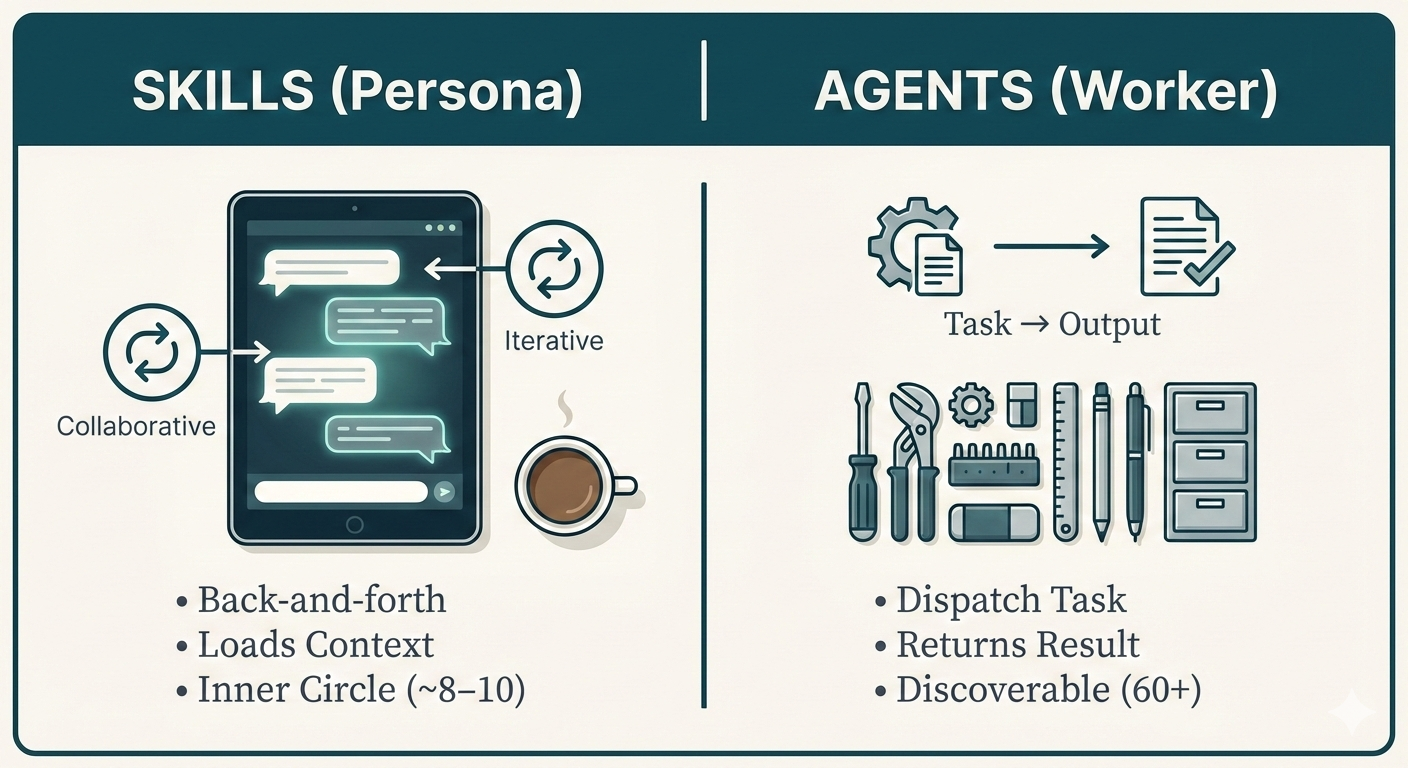
In Claude, a skill is a persona you talk with. It loads context into your current session. It’s collaborative: back-and-forth, iterative.
An agent is a worker you dispatch. You send it a task. It returns a result. No conversation needed, just output.
Two modes. That’s the framework.
My “inner circle” skills are the ones I want to converse with (maybe 8—10): orchestrator, designer, implementer.
Everything else: protocol specialists, QA sub-agents, sync agents — are workers. They live in subdirectories, organized however makes them easy to find and easy to delegate.
70+ agents sounded unmanageable. Turns out only ~10 needed to be conversational. The rest just needed to be discoverable.
Not every agent needs a seat at the table. Most just need a job description.
The line is blurrier in practice: some workers eventually get “promoted” into skills when I realize I need iteration.
What’s the agent count where organization starts breaking down for you?