Heart Rate Training Zones for Rowing
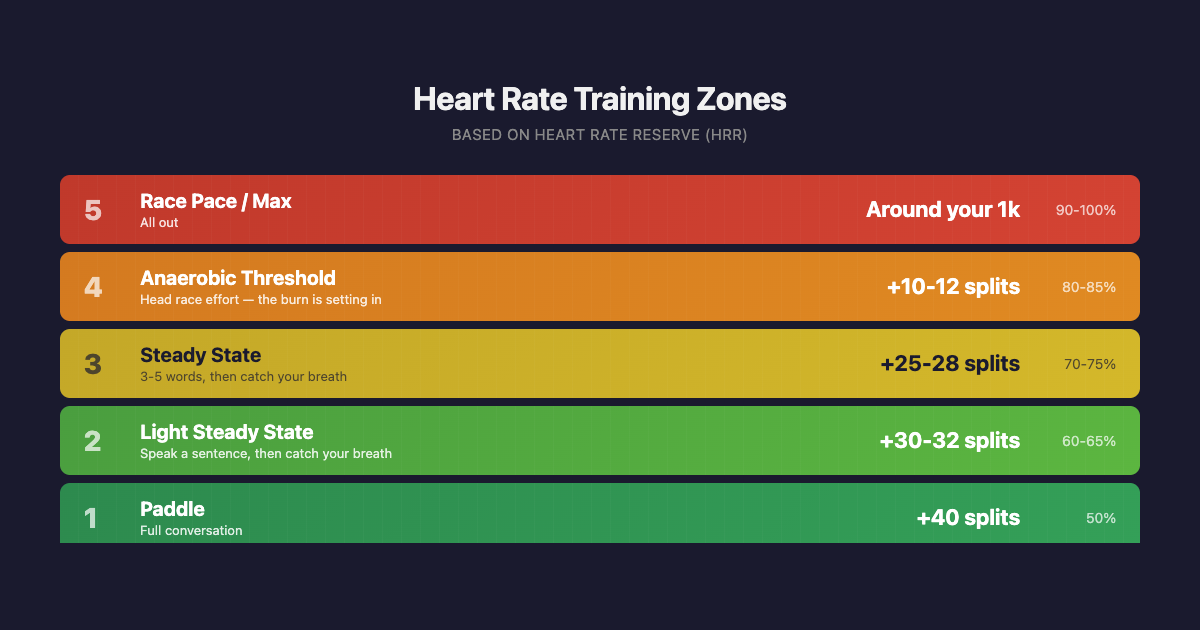
I’ve gotten some questions about training as it relates to heart rate, so I thought I’d lay out how I think about it.
Exercise physiologists have shown that the best way to maximize training effectiveness and minimize injury is to use training zones. A proper training plan alternates between easy and hard efforts. You can’t go all out every day — and you shouldn’t.
I prefer to think in more intuitive terms: SS (steady state), AT (anaerobic threshold), and UT (utilization training). But the foundation underneath all of that is heart rate.
Three Ways to Gauge Intensity
There are three ways to tell if you’re going hard enough — or too hard:
- Physiological Self-Assessment (PSA) — how your body feels and whether you can talk
- Heart Rate (HR) — the most specific and objective measure
- Split (SP) — your pace on the erg or water
All three have their place. But heart rate is the anchor.
Calculating Your Zones with Heart Rate Reserve
Most people use a method called heart rate reserve (HRR). The formula is simple:
HRR = Max Heart Rate - Resting Heart Rate
Then for each zone, you calculate:
Target HR = (HRR x Zone %) + Resting HR
For a 40-year-old male with a resting heart rate of 55 and a max of 190, the reserve is 135. Here’s what each zone looks like with those numbers:
1. Paddle (50% HRR)
- PSA: You can have a full conversation.
- HR: ~123 bpm (135 x 0.50 + 55)
- Split: 40 splits above your 1k, or 30 splits above your 15-min pace.
2. Light Steady State (60-65% HRR)
- PSA: You can speak a whole sentence, then need to catch your breath.
- HR: ~136-143 bpm
- Split: 30-32 splits above your 1k, or 15-20 splits above your 15-min pace.
3. Steady State (70-75% HRR)
- PSA: You can get out 3-5 words, then need to catch your breath.
- HR: ~150-156 bpm
- Split: 25-28 splits above your 1k, or 10-12 above your 15-min pace.
4. Anaerobic Threshold (80-85% HRR)
- PSA: What you feel like in a head race. Not so bad at first, but the burn is setting in.
- HR: ~163-170 bpm
- Split: 10-12 splits above your 1k, or 0-2 splits above your 15-min pace.
5. Race Pace / Max (90-100% HRR)
- PSA: Pretty much all out.
- HR: ~177-190 bpm
- Split: Around your 1k pace — sometimes 1-2 splits below, sometimes 1-2 above depending on the piece.
Using Zones to Track Real Progress
Once you know your zones, you can use them to give yourself a break from the split while still feeling improvement. This is the part most people miss.
Here’s what I mean. In college, I pulled several 60-minute pieces on the erg each week. I knew it wasn’t smart to go all out every time, so I built a system that let me feel progress without redlining.
I picked a split that kept my average heart rate around 155 bpm for the full 60 minutes. That started at a 1:59 split. I would keep pulling workouts at that split until my average heart rate for the piece dropped below 145 bpm. This progress usually took a few weeks. Then I’d drop the split by one — to 1:58 — and repeat the process. Then 1:57. Then 1:56.
After several months, I was pulling those 60-minute pieces at a 1:52 split with an average heart rate of 150 bpm. That’s real, measurable progress. I could now pull a 1:52 with the same effort it used to take to pull a 1:59. And I knew my next erg test would be faster because of this fitness.
The Takeaway
This illustrates the exact type of fitness gains that are possible when you forget your goal — the 1k test — and focus on the process. If you build milestones along the way that let you track small achievements, you get a constant sense of improvement. That’s what keeps you coming back.
You should definitely not try pulling 60-minute pieces on the erg. But you can apply the same mindset to any steady state workout we do. Pick something like our 3 x 12 minutes on, 3 minutes off and use the same methodology: hold a target split, wait for your heart rate to drop at that pace, then lower the split.
As your steady state fitness improves, it will correspondingly improve both your 15-minute and 1k splits. Trust the process.